

Project controls
Make performance visible. Make recovery credible.
Cost, schedule, change, risk, and performance controls that help leaders intervene while recovery choices remain open.
Control the forecast
Turn variance into an intervention while options remain open.
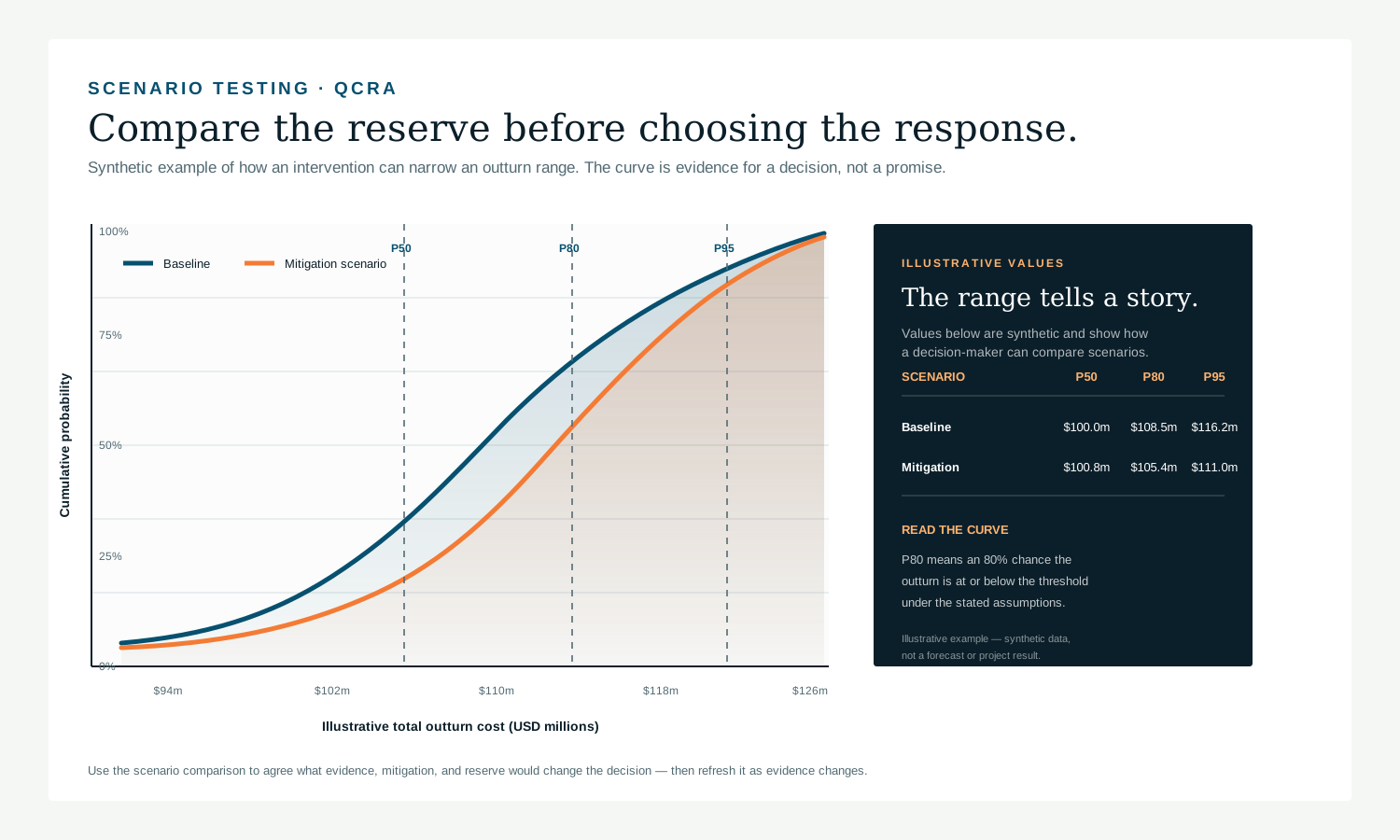
Confidence curves and scenario comparisons give the PMO a common language for baseline health, recovery choices, reserve, and escalation.
View illustrative values
| Scenario | P50 | P80 | P95 |
|---|---|---|---|
| Baseline | 100.0 | 108.5 | 116.2 |
| Mitigation | 100.8 | 105.4 | 111.0 |
View illustrative values
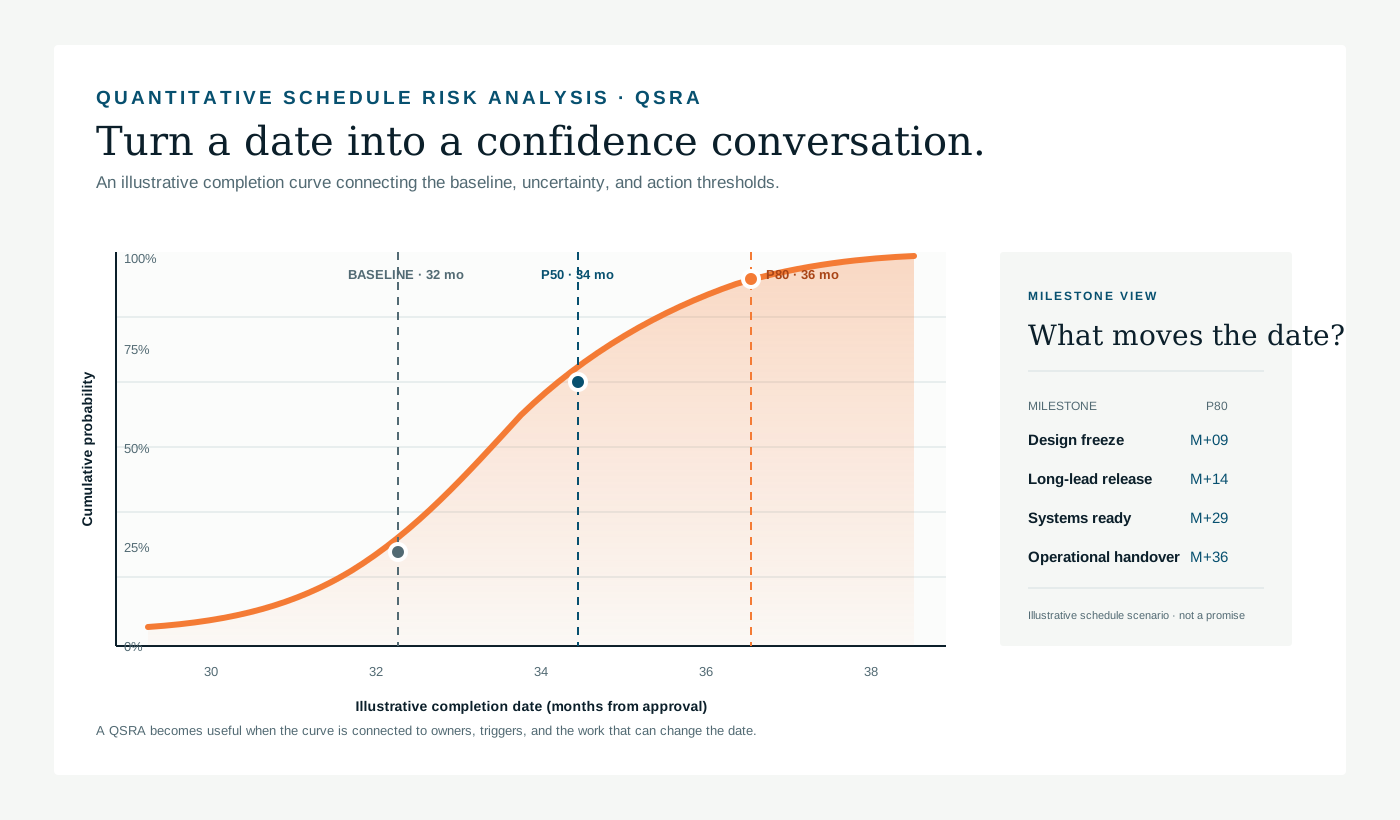
| View | Completion | Interpretation |
|---|---|---|
| Baseline | 32 months | Reference plan |
| P50 | 34 months | Median modelled outcome |
| P80 | 36 months | 80% at or below under assumptions |
View illustrative values
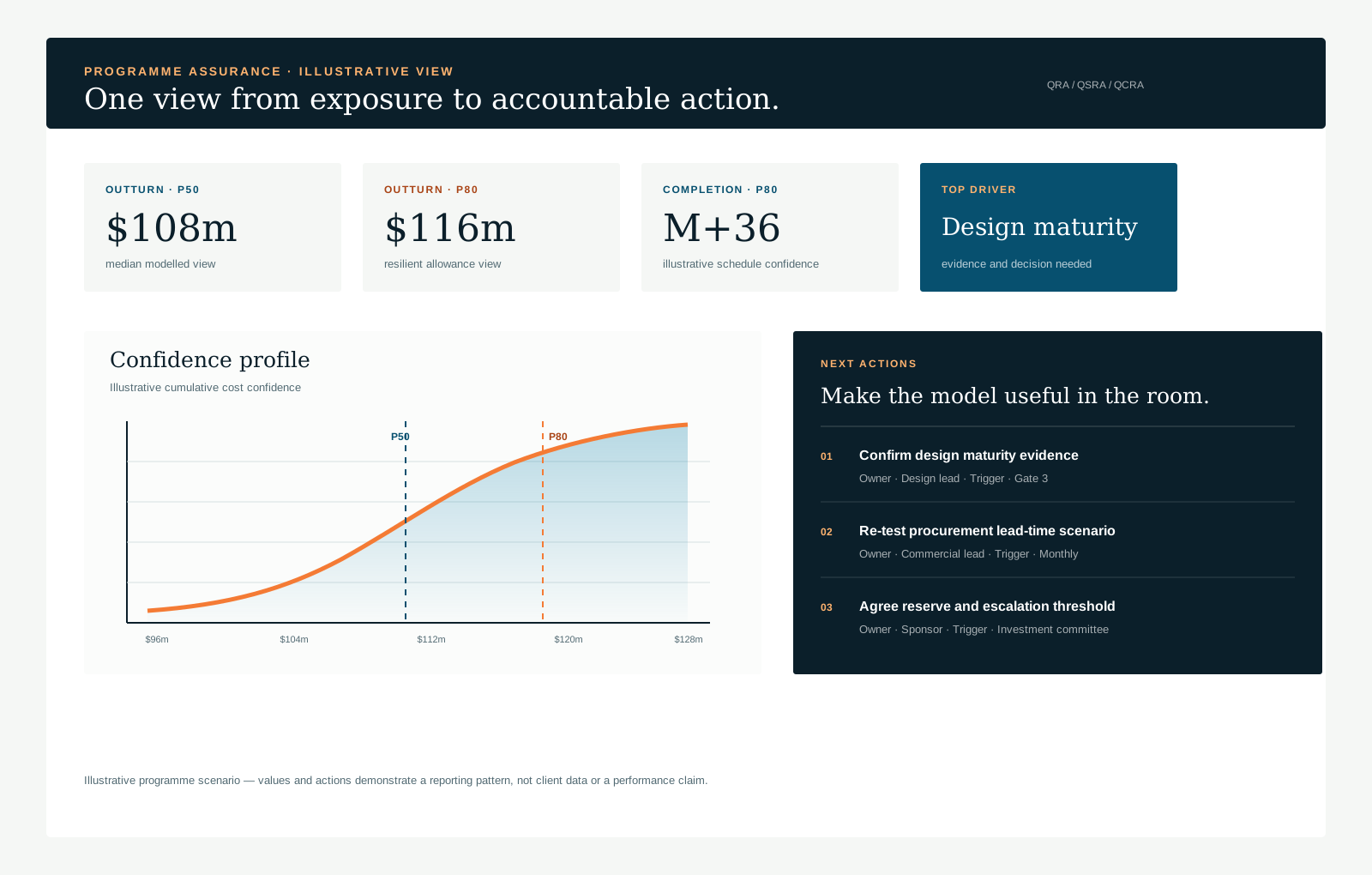
| Signal | Illustrative value | Decision use |
|---|---|---|
| Outturn P50 | $108m | Median reference |
| Outturn P80 | $116m | Resilient allowance view |
| Completion P80 | M+36 | Schedule confidence |
| Top driver | Design maturity | Evidence and owner needed |
How to read the example
A curve is only as credible as the baseline, distributions, dependencies, and update discipline behind it. Refresh the model when evidence changes.
Project controls
Make performance visible. Make recovery credible.
Sponsors, programme leaders, PMOs, delivery partners, and lenders facing weak baselines, unreliable forecasts, or a recovery gate.
We start with the decision and work backwards to the evidence, the people, and the controls required to make it defensible. The scope is proportionate to the consequence and designed to remain useful after the engagement.
Common triggers
- Cost and schedule forecasts no longer agree
- Change is accumulating without a clear decision route
- A programme needs a recovery plan before the next governance gate
- The PMO produces information but not management control
Where we help
- Baseline health and readiness review
- Integrated cost and schedule control model
- Estimate-to-complete and forecast assurance
- Change, trend, risk, and performance reporting
- Recovery plan, governance rhythm, and implementation support
Advice should leave a decision behind.
We make assumptions, dependencies, owners, and next actions visible so the work can move into governance and delivery.
What changes
A stronger view of the next move.
The output is not activity for its own sake. It is greater confidence in what to protect, what to challenge, and what to do next.
Earlier visibility of variance and consequence
A sequenced recovery plan with accountable owners
Governance conversations focused on decisions rather than activity
Frequently asked questions
A clear start to the conversation.
These answers describe how we typically begin. The right scope depends on the decision and context.
What does a typical engagement include?
We agree the decision, evidence, scope, outputs, and governance route at the outset. The work may be a focused review, a workshop-led assessment, or support through an active decision gate.
How quickly can you help?
Timing depends on the decision and the evidence available. Use the contact form to describe the urgency and we will respond with a proportionate next step.
Will the work replace our existing advisers?
Usually not. We work alongside existing teams and advisers, adding an independent view where the decision, record, or accountability needs greater clarity.
Related capabilities
Connected support when the situation crosses disciplines.
Complex decisions rarely stay inside one service line.
Related sectors
Context that sharpens the question.
Sector experience helps us recognise the interfaces and promises around the decision.
Start with the decision
Bring us the question behind the request.
Share the context, timing, and consequence. We will respond with a proportionate next step.
Open the contact form