

Risk leadership
See the exposure. Choose the response. Protect the outcome.
Project and enterprise risk management, claims, delay, disruption, and dispute advisory grounded in evidence.
Exposure and entitlement
Make the moving parts visible before positions harden.
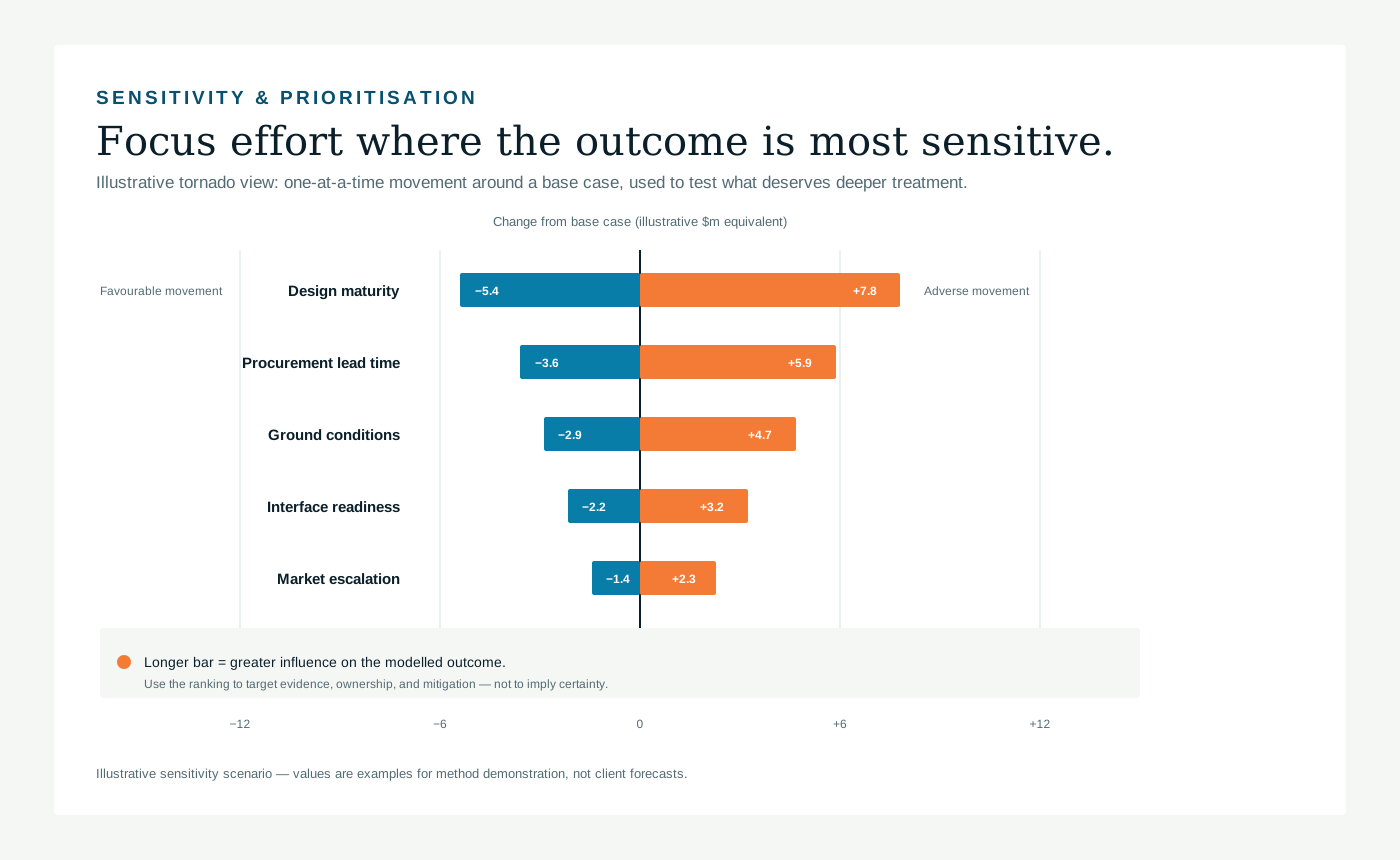
A sensitivity view helps separate the drivers that deserve evidence, mitigation, or a clear record from the noise around an active claim or recovery effort.
View illustrative values
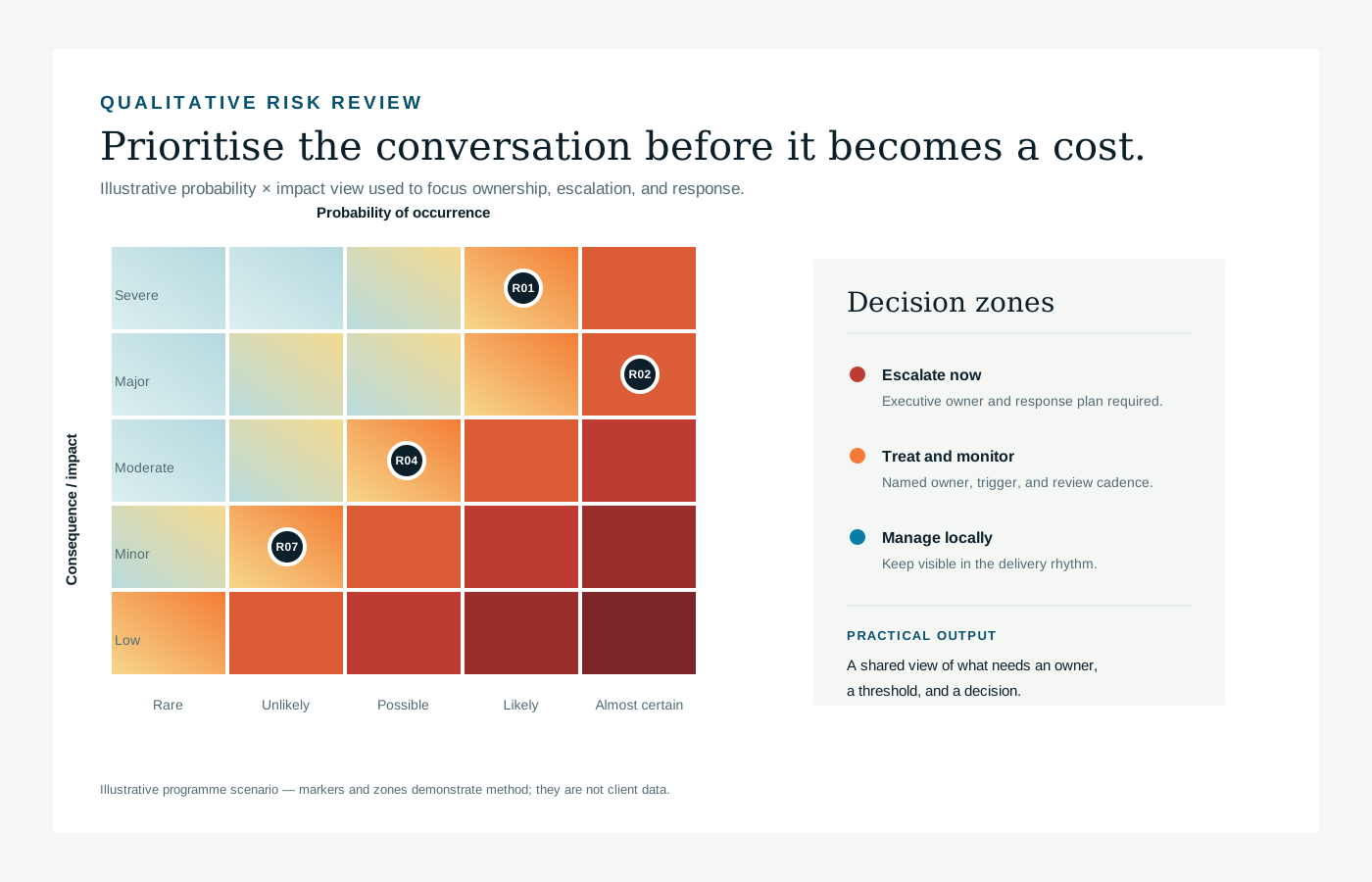
| Marker | Likelihood | Impact | Decision zone |
|---|---|---|---|
| R01 | Likely | Severe | Escalate now |
| R02 | Almost certain | Major | Escalate now |
| R04 | Possible | Moderate | Treat and monitor |
| R07 | Unlikely | Minor | Manage locally |
View illustrative values
| Driver | Favourable | Adverse |
|---|---|---|
| Design maturity | −5.4 | +7.8 |
| Procurement lead time | −3.6 | +5.9 |
| Ground conditions | −2.9 | +4.7 |
| Interface readiness | −2.2 | +3.2 |
| Market escalation | −1.4 | +2.3 |
View illustrative values
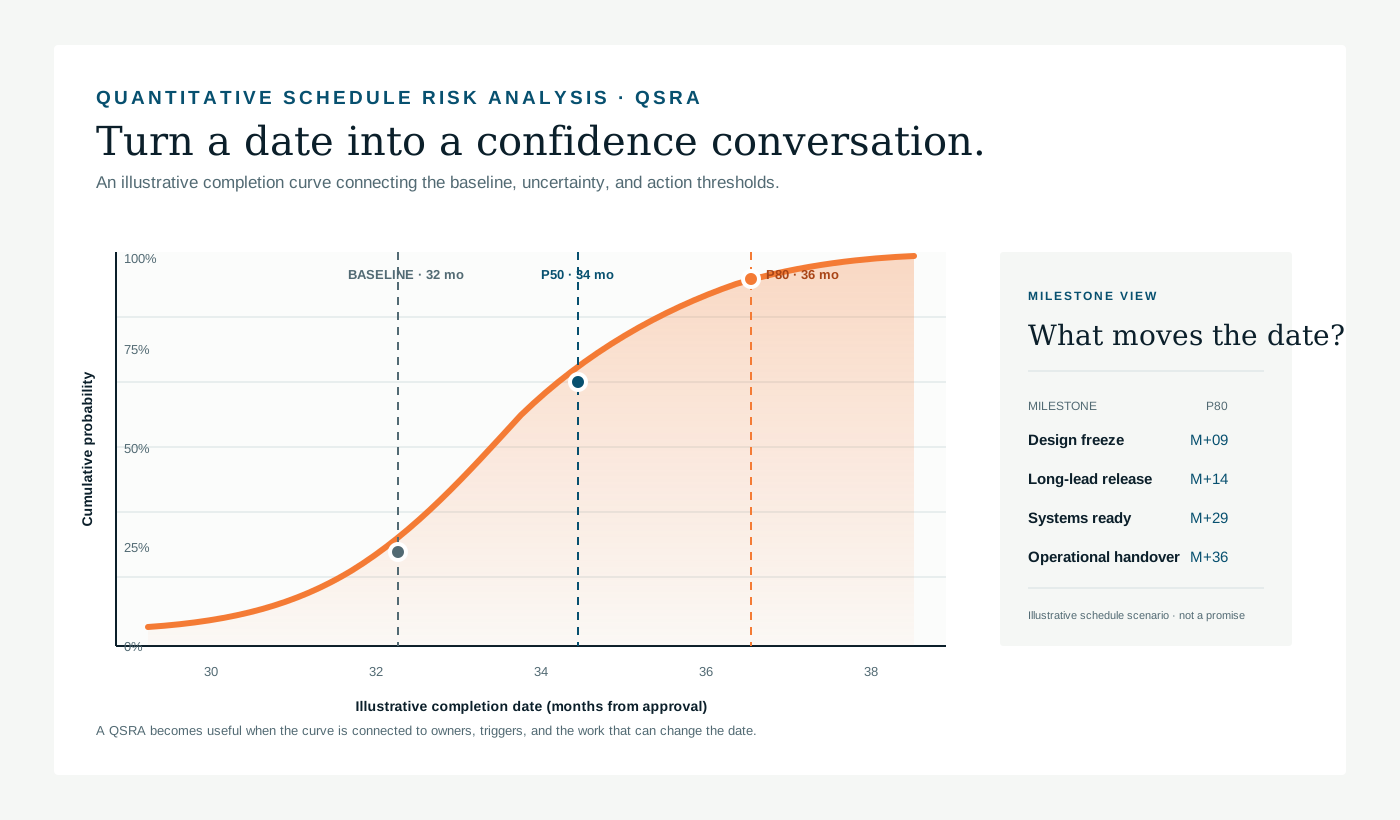
| View | Completion | Interpretation |
|---|---|---|
| Baseline | 32 months | Reference plan |
| P50 | 34 months | Median modelled outcome |
| P80 | 36 months | 80% at or below under assumptions |
How to read the example
Sensitivity is not entitlement. A live claim requires a tested record, contract context, causation analysis, and transparent assumptions.
Risk leadership
See the exposure. Choose the response. Protect the outcome.
Owners, boards, programme directors, contractors, lenders, and counsel who need an independent view of exposure or entitlement.
We start with the decision and work backwards to the evidence, the people, and the controls required to make it defensible. The scope is proportionate to the consequence and designed to remain useful after the engagement.
Common triggers
- A material risk is moving faster than the reporting cycle
- A claim or potential dispute is changing commercial relationships
- A board or investment committee needs a defensible decision paper
- An enterprise risk framework is not reaching operational teams
Where we help
- Risk taxonomy, appetite, and governance design
- Qualitative and quantitative exposure analysis
- Scenario, sensitivity, and contingency analysis
- Delay, disruption, entitlement, causation, and quantum review
- Executive decision packs and negotiation support
Advice should leave a decision behind.
We make assumptions, dependencies, owners, and next actions visible so the work can move into governance and delivery.
What changes
A stronger view of the next move.
The output is not activity for its own sake. It is greater confidence in what to protect, what to challenge, and what to do next.
Clear owners, thresholds, and response actions
A record-based position that can withstand scrutiny
A route to resolution, recovery, or controlled escalation
Frequently asked questions
A clear start to the conversation.
These answers describe how we typically begin. The right scope depends on the decision and context.
What does a typical engagement include?
We agree the decision, evidence, scope, outputs, and governance route at the outset. The work may be a focused review, a workshop-led assessment, or support through an active decision gate.
How quickly can you help?
Timing depends on the decision and the evidence available. Use the contact form to describe the urgency and we will respond with a proportionate next step.
Will the work replace our existing advisers?
Usually not. We work alongside existing teams and advisers, adding an independent view where the decision, record, or accountability needs greater clarity.
Related capabilities
Connected support when the situation crosses disciplines.
Complex decisions rarely stay inside one service line.
Related sectors
Context that sharpens the question.
Sector experience helps us recognise the interfaces and promises around the decision.
Start with the decision
Bring us the question behind the request.
Share the context, timing, and consequence. We will respond with a proportionate next step.
Open the contact form